
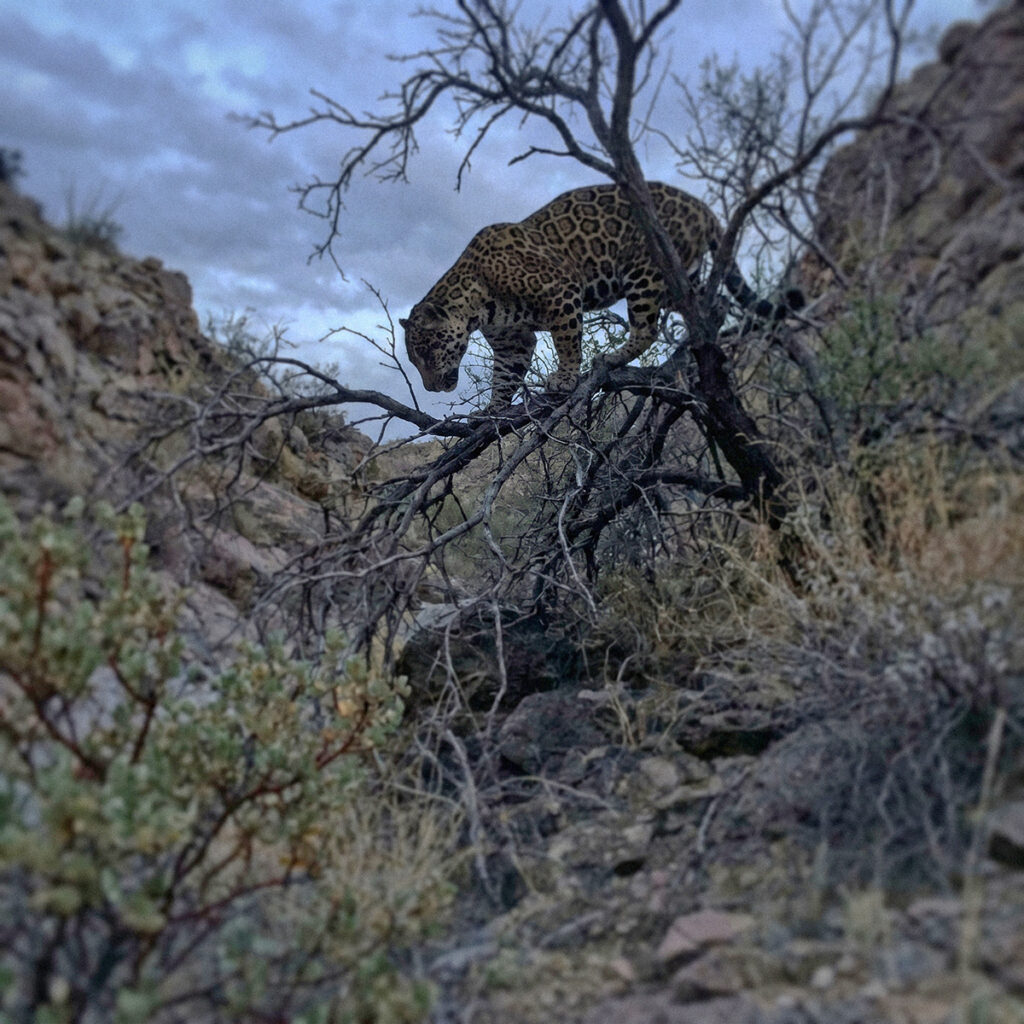
On the evening of November 19, 2011, a man named Donnie Fenn was hunting mountain lions with hounds in a dry canyon of the Whetstone Mountains in southeastern Arizona. His ten-year-old daughter Alyson was with him.
The dogs found something on a rocky outcrop ahead of them. Fenn caught up and stopped.
It was not a mountain lion. It was a jaguar.
The cat was large, roughly two hundred pounds, heavily muscled, its coat covered in the rosettes of an animal that had not been part of the American landscape in living memory. It climbed a tree without hurry and looked down at Fenn, his daughter, and the dogs. Fenn held the dogs back and raised his camera.
The jaguar came down the trunk. The dogs pressed close. The cat swatted at them with one paw, leaving minor puncture wounds on a few of the hounds, then turned and climbed a second tree a short distance away. It settled on a branch twenty feet above the ground and watched.
Fenn called the dogs off.
The jaguar came down again. It looked at them for a moment, then walked into the scrub oak and disappeared. The entire encounter lasted minutes. It did not run. It left.
That night Fenn contacted the Arizona Game and Fish Department. The photographs showed a healthy adult male jaguar. Hair samples collected at the scene confirmed it. Researchers gave him a name. El Jefe. The Boss.
Over the following four years, remote cameras in the nearby Santa Rita Mountains photographed El Jefe more than a hundred times. He moved through the Sky Island ranges alone, hunting deer and javelina along corridors his species had used before ranchers and bounty hunters cleared them from the region in the early twentieth century. He crossed canyons. He left scat on ridgelines. He was, as far as anyone could determine, the only wild jaguar in the United States.
Then in September 2015, the cameras stopped capturing him. He was gone.
For seven years there was nothing. No photographs. No tracks. No scat. No confirmed sighting anywhere in the United States.
In August 2022, researchers working in central Sonora, Mexico, more than a hundred miles south of his last known Arizona location, identified him on a trail camera. He was older. He was moving more slowly. He was alive.
Jaguars once ranged as far north as the Grand Canyon. They lived in California, in New Mexico, in Texas, in Louisiana. The last female jaguar documented in the United States was killed in the White Mountains of Arizona in 1963. Since then, every jaguar confirmed on American soil has been a lone male walking north from Mexico. Testing the edge. Passing through. None of them have stayed.
El Jefe stayed longer than any of them. Four years in the mountains of southern Arizona. A hundred trail camera photographs. And then he turned around and walked back to Mexico, for reasons nobody has been able to explain.
The part of this story that people carry with them afterward is the tree. A jaguar, twenty feet above a man and his ten-year-old daughter and a pack of dogs, looking down at all of them with the unhurried calm of an animal that has already decided what it is going to do. It chose to leave. Not because it was afraid. Because it was done.