
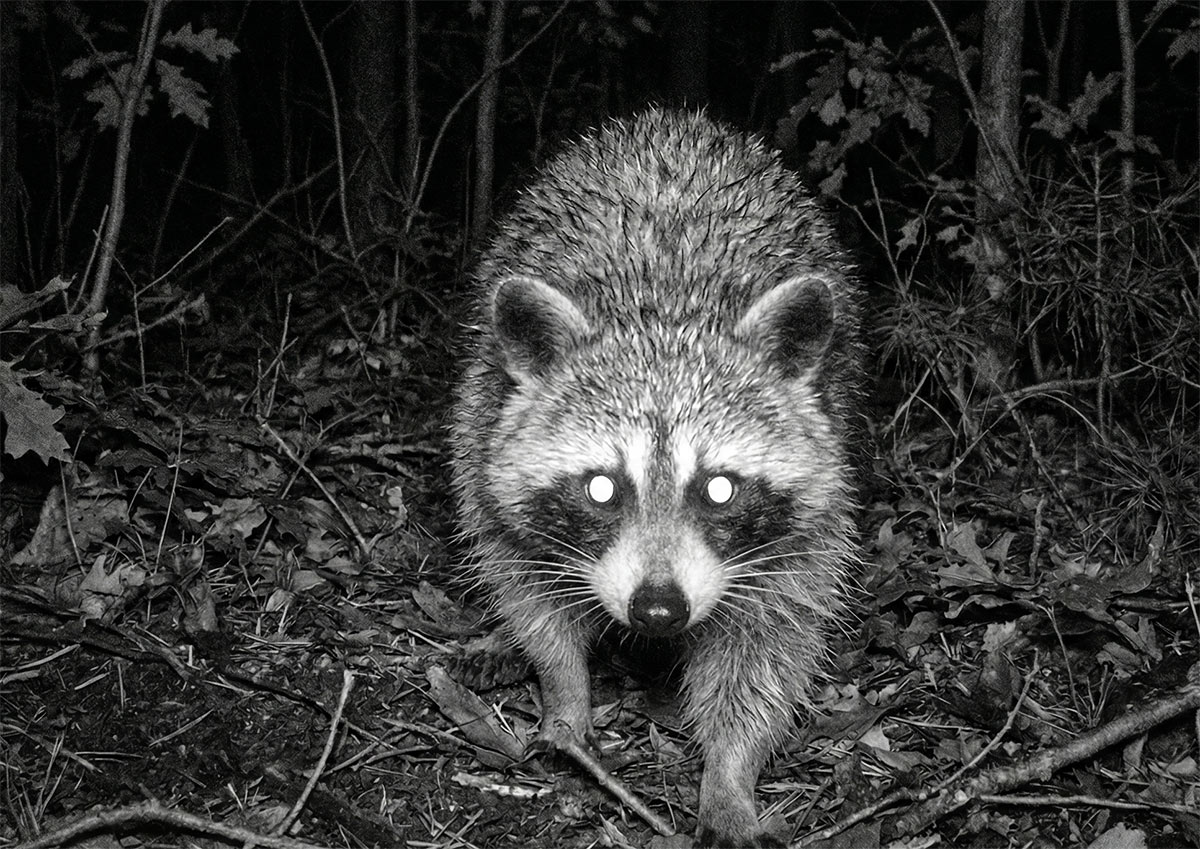
You probably think you know raccoons. Masked, chubby, digging through your trash at 2am. A nuisance at best, a pest at worst. Turns out, scientists have been quietly piecing together a very different picture, and the animal that emerges from the latest research is stranger, smarter, and more unsettling than anything you had in mind.
1. They Were Too Smart for the Lab
Before rats took over animal intelligence research, raccoons were the top candidates. Scientists in the early 20th century ran problem-solving experiments on them and found their abilities closer to primates than to dogs or cats. Then the wheels came off. In one study, every single raccoon escaped through the laboratory ventilation system. Not some of them. All of them. Researchers packed up, switched to rats, and raccoons disappeared from the scientific literature for decades. Not because they failed. Because they were too difficult to contain.
2. Their Brain Is Wired More Like a Primate Than a Dog
Raccoons have a relatively small brain, but what is inside it punches well above its weight. Vanderbilt University researchers found that raccoons pack around 438 million neurons into that small brain, a density far closer to primates than to other carnivores of similar size. For comparison, a dog has more neurons in total, but far fewer per unit of brain volume. The raccoon’s cerebral cortex, the part responsible for thinking, learning, and problem-solving, is structured more like a monkey’s than like any other common urban animal.
3. They Can Mentally Rehearse Solutions
This one stopped researchers cold. In controlled studies, raccoons were able to learn how to solve a task, walk away, and come back later to solve it correctly without needing to relearn the steps. Dogs and rats tested in similar conditions needed to stay continuously focused on the problem to solve it. The raccoon could apparently turn it over in its head and come back ready. Scientists have since speculated this points to a form of mental imagery, the ability to simulate a solution internally before acting. That is a cognitive capability most people would not expect from an animal that raids compost bins.
4. Some of Them Let Others Do the Work
A 2024 study published in the Proceedings of the Royal Society B placed puzzle boxes in urban backyards and watched what happened on night vision cameras. One raccoon shoved a skunk out of the way and opened a complex latch to get to the food inside. That part is impressive enough. But then another raccoon showed up, watched the first one crack the puzzle, waited for it to open the compartment, and shoved the solver aside to take the reward without doing any of the work. Scientists call it social scrounging. Most people would call it something else.
5. They Don’t Wash Their Food
The cotton candy video broke the internet. A raccoon carefully washing its candy floss in a stream, only to watch it dissolve, looking genuinely confused. The assumption has always been that raccoons wash food for hygiene. That is not what is happening. Raccoons wet their paws to enhance their sense of touch. Their forepaws are packed with nerve endings, and moisture activates them, giving the animal a more detailed tactile read of whatever it is handling. They are not cleaning dinner. They are feeling it more carefully. The cotton candy dissolved because no one told it that was going to happen.
6. Their Hands Are Mapped Like Human Hands in the Brain
The raccoon’s forepaws take up a disproportionately large amount of real estate in its brain, mapped onto the cerebral cortex in a way that closely mirrors how human hands are represented in our own brains. Researcher Kelly Lambert noted that the hand is where the mind meets the world, and in raccoons, that is literally true at a neurological level. They navigate and understand their environment primarily through touch, not sight. That is why they perform better on tests that use tactile buttons than visual cues, and why they can open latches in complete darkness.
7. Urban Raccoons Are Physically Evolving
A 2025 study analyzed nearly 20,000 photographs of raccoons across the United States and found that urban raccoons have measurably shorter snouts than their rural counterparts, around 3.5% shorter on average. That might not sound like much, but it matches a known pattern called domestication syndrome, the same set of physical changes seen in wolves as they began the long process of becoming dogs. Shorter face, reduced fear response, increased tolerance of humans. Researcher Raffaela Lesch described it as potentially the earliest documented case of domestication happening in real time, driven not by human selection but by raccoons choosing to live near human trash.
8. They Remember Solutions for Years
Once a raccoon figures out how to open a specific latch or lock, it does not forget. Studies have tracked individuals recalling exact solutions to complex tasks for up to three years after first learning them. This long-term retention is what makes the ongoing arms race between raccoons and trash can designers so one-sided. Every new lock is a puzzle that gets solved once, then filed away permanently. The raccoon does not need to figure it out again. It already knows.
9. City Roads Act as a Natural Intelligence Filter
Urban raccoons that survive long enough to reproduce are, statistically, the ones smart enough to avoid major roads. Researcher Suzanne MacDonald at York University describes it as a Darwinian selection process happening under our headlights. The less cautious animals get killed by traffic. The ones with better spatial awareness and risk assessment survive, breed, and pass those traits on. The raccoons currently living in your city are the descendants of generations of survivors. They are not the average raccoon. They are the ones that made it.
10. They Might Be the Next Domestic Animal
Pull all of this together and a pattern emerges that is hard to ignore. Urban raccoons are physically changing to look less threatening. They are becoming more tolerant of humans. They are concentrated around human food sources in the same way wolves once were around human settlements. Lesch’s research draws a direct comparison to the early stages of dog domestication, which began with wolves scavenging human waste tens of thousands of years ago. Nobody decided to domesticate the wolf. The wolf decided to hang around. The raccoon is doing the same thing right now, and we are watching it happen without fully realizing what we are seeing.
The animal going through your bins at night is not just a pest. It is one of the most cognitively complex urban mammals on the planet, currently in the middle of an evolutionary experiment it started on its own. Science is only just catching up.