
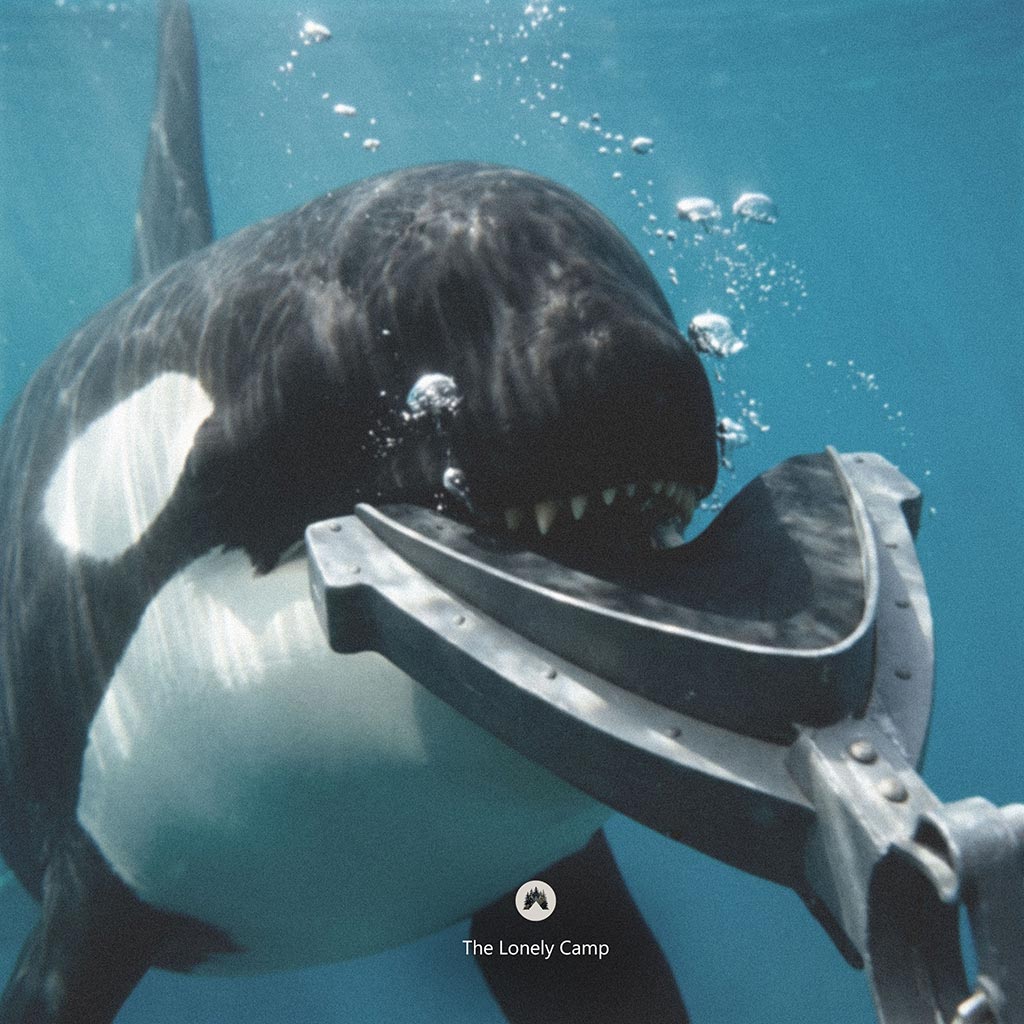
In October 1968, the U.S. Navy captured two male killer whales in Puget Sound and a short-finned pilot whale in the Catalina Channel off southern California. The orcas were named Ahab and Ishmael, while the pilot whale was named Morgan. Flown first to the Navy's bioscience facility at Point Mugu, California, all three were eventually shipped to the Naval Undersea Center at Kaneohe Bay on Oahu's windward coast to begin a classified salvage program called Project Deep Ops.
The Navy wanted to find out if large whales could do work that human divers and submersibles of the era could not handle. The goal was to train the animals to swim down to the ocean floor, home in on the acoustic pinger of a lost dummy torpedo, clamp a mechanical recovery collar around the casing, and swim back to the surface. Earlier trials at Point Mugu under scientist Forrest Wood had already proven that dolphins and sea lions could mark sunken hardware at depths down to 150 feet. Moving into deep water required bigger lungs and heavier animals.
Ahab was the largest of the three, measuring 19 feet and weighing 5,500 pounds at roughly nine or ten years old. Ishmael was two feet shorter and 1,000 pounds lighter, while Morgan measured 12 feet and weighed 1,200 pounds. By January 1970, the three whales were stationed in Hawaii and trained to follow motorboats into the open channel between Oahu and Molokai five days a week.
Wearing backpack harnesses fitted with radio beacons, they learned to answer underwater recall buzzers and carry a mouthpiece attached to a spring-loaded grabber claw. Once pressed against a sunken cylinder, the claw locked onto the target and inflated a hydrazine gas float bag to lift the object to the surface.
Back at Kaneohe Bay, the whales lived inside chain-link ocean pens where the top of the fence sat barely a foot above the water at high tide. Navy researcher Clark Bowers noted that none of the animals ever tried to jump the wire.
On the open range, Morgan was the slowest learner in the group, yet he turned out to be the best deep-water worker, just as the biologists had predicted. Because wild pilot whales hunt squid in dark water, Morgan had no problem dropping into the abyss. Twice during training he dove to 1,654 feet to deploy practice hardware, setting a depth record for a trained marine mammal.
Then, in February 1971, the entire program fell apart in a single month.
When a target recovery line snapped in 750 feet of water, trainers sent Ahab down twice with live grabber claws to salvage the gear on the bottom. Both times, the mouthpiece jammed and failed to release cleanly from the target. Rattled by the malfunction on the seafloor, the 5,500-pound orca went into a month-long sulk in his pen, refusing to work or eat. At the exact same time, Morgan entered a breeding rut and refused to follow the workboat out of the bay, spending his days trying to mate with the transport cage and the crew's rubber raft while trainers stayed out of the water.
During the last week of that same month, on February 19, 1971, Ishmael came up from a routine 500-foot dive in the Molokai Channel, spat out his mouthpiece, slapped the swells with his tail flukes, and swam straight out into the open Pacific. His radio backpack failed soon after. Although his handlers believed he would have returned to the boat if they had been able to keep a signal on him, Ishmael was never seen again.
That June, Ahab pulled off his finest working dive, holding his breath for seven minutes and 40 seconds to clamp a recovery device onto a dummy torpedo resting 850 feet down. Four days later, he decided to take an unscheduled trip of his own. Instead of returning to the workboat, Ahab turned northwest toward Kahuku at the northern tip of Oahu.
The crew trailed him in the boat for the next 14 and a half hours, unable to turn him back. According to the official report by Bowers and Navy colleague C.A. Henderson, "he would answer the recall and follow the boat only if the crew's plans followed his." After swimming 50 nautical miles and taking a three-hour nap offshore, Ahab woke up, answered the underwater buzzer, and swam peacefully back to his pen.
Ahab died in Hawaii in September 1972, and Morgan died five months later in February 1973. In their final report, Navy researchers concluded that whales could indeed salvage deep-ocean ordnance, though they recommended using pilot whales rather than killer whales for future missions. While a killer whale named Shamu was jumping in front of 5,000 cheering tourists a day at SeaWorld in San Diego, Ahab and Ishmael had spent their afternoons diving hundreds of feet into the dark off Oahu with nobody watching at all, working for the exact same daily bucket of 150 pounds of fish.
Image is for illustration purposes only.
Source: Bowers & Henderson (1972), NUC TP 306, Project Deep Ops / Sports Illustrated (1974) / National Archives / Cetabase Navy Orca Records.