
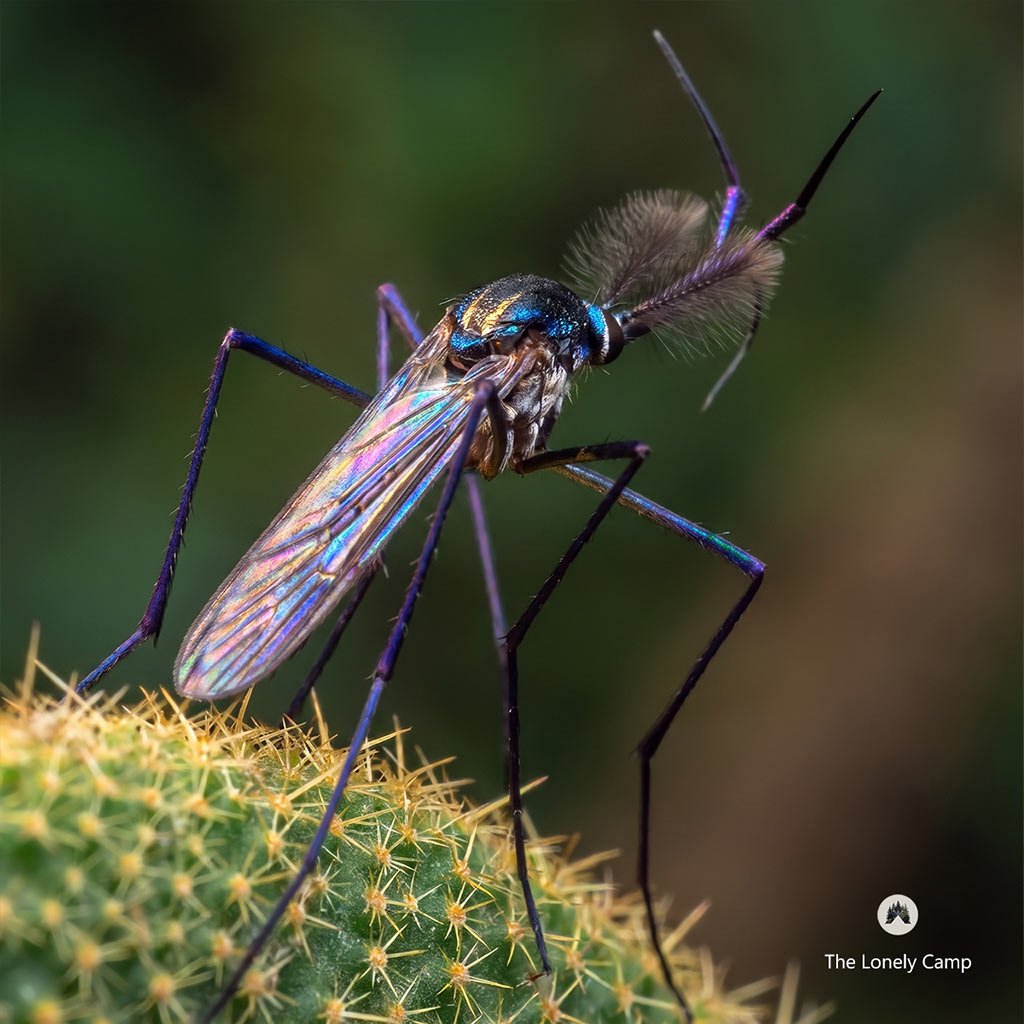
The elephant mosquito is the largest mosquito in North America. It physically cannot bite, but its young spend their lives slaughtering the mosquitoes that do.
While standard female mosquitoes drink human blood to get the protein needed to lay eggs, adult elephant mosquitoes live strictly on flower nectar, tree sap, and rotting fruit. Their mouthparts are bent into a rigid downward hook built for probing blossoms, making it impossible for them to pierce through skin of any type. They never drink blood and never spread disease.
Instead, they hunt down the bloodsuckers before they can ever leave the water.
The worst disease-carrying mosquitoes in American backyards, including the Asian tiger mosquito and the yellow fever mosquito that transmit dengue, Zika, and West Nile virus, do not breed in big swamps or ponds where city trucks can easily spray larvicide. They lay their eggs in tiny, hidden pockets of rainwater trapped inside old tires, clogged rain gutters, forgotten flowerpots, and hollow trees.
Those exact same dark puddles are where the female elephant mosquito drops her eggs, flicking them one by one onto the water while flying vertical loops in the air.
What hatches is a heavy, worm-like ambush predator that grows to nearly a full inch long. Hanging motionless in the dark water, the elephant mosquito larva waits to feel the slightest vibration of a passing mosquito wriggler. When a pest larva swims within reach, the giant strikes with hinged jaws. Before it ever grows wings, a single elephant mosquito larva can devour up to 5,000 smaller larvae.
Then, during the final 24 hours before it turns into a pupa, the larva goes on a relentless killing spree.
Because a mosquito pupa has no mouthparts and cannot fight back while transforming into an adult, the larva spends its last day snapping the necks of every living creature left in the container. Even when its stomach is completely full, it grabs other mosquito larvae, crushes them, and drops the bodies to the bottom without eating a bite, wiping out the entire puddle so nothing is left alive to chew on it while it rests.
Public health officials have spent decades trying to turn that appetite into a city-wide weapon. When researchers released lab-reared elephant mosquitoes across a test neighborhood in New Orleans in 1982, the populations of biting Aedes and Culex mosquitoes dropped by 74 percent within ten weeks.
The only catch was rearing them in bulk. Because elephant mosquito larvae are fierce cannibals that will happily eat their own brothers and sisters in crowded lab trays, raising millions of them by hand proved too expensive for most cities.
In 2019, mosquito control scientists in Harris County, Texas, surrounding Houston, finally cracked the mass-rearing problem, breeding the benign giants in specialized labs and releasing them into neighborhoods to hunt down disease vectors inside the hidden backyard puddles that chemical spray trucks can never reach.
Image is for illustration purposes only.
Source: Alomar & Alto, UF/IFAS (2022) / Focks et al. (1982), Journal of Medical Entomology / Campos & Lounibos (2000) / Schiller et al. (2019), Harris County Public Health.